Thursday, January 8, 2026

Paper Boats” by Rabindranath Tagore:

 “Paper Boats” by Rabindranath Tagore:

A. Answer the questions
1. What does the speaker load his boats with?
The speaker loads his paper boats with shiuli flowers from his garden.

2. What does he hope will happen to the load he puts on the boats?
He hopes that the flowers will be carried safely to land during the night.

3. What are the clouds compared to?
The clouds are compared to boats with white bulging sails.

4. What does the speaker dream of? How does the load on the boat change from the earlier one?
A- The speaker dreams that his paper boats sail under the night stars, and fairies replace the flowers with baskets full of dreams.

B. Answer with reference to the context
1. “In big black letters I write my name and the name of the village where I live.”

a. What is the speaker playing with?
The speaker is playing with paper boats.

b. What does he write his name on?
He writes his name on the paper boats.

c. Why do you think he writes the name of his village as well?
He writes the name of his village so that whoever finds the boat will know where he comes from.

2. “I know not what playmate of mine in the sky sends them down the air to race with my boats!”

a. How old do you think the speaker is?
The speaker seems to be a young child.

b. What does the playmate send down from the sky?
The playmate sends down the clouds from the sky.

c. Why do you think the speaker imagines a race?
The speaker imagines a race because the clouds seem to move with his paper boats.


Class 4th
Subject English 
Topic - Paper Boats ( Poem) 

Write Rhyming words 

1. stream
2. one
3. live
4. land
5. night
6. sky
7. sails
8. race
9. stars
10. dreams

Make sentences of the following 
1. Boat
2. Black
3. Village 
4.Strange
5. Flower 
6. Garden 
7. Sky
8. Cloud 
9. Race
10. Stars
11. Basket 
12. Dreams 


3rd The Rabbit Poem ( Back Exercise)


“The Rabbit”:
A. Answer the following questions
1. What is the speaker doing? Is she alone?
* The speaker is hiding under a thick grapevine. She is not alone because a rabbit comes near her.

2. What comes out of the grass, where the speaker is hiding?
* A little gray rabbit comes out of the grass.

3. How do the speaker and the rabbit react to seeing each other?
* The rabbit looks hard at the speaker. The speaker also looks back very hard at the rabbit. 

4. How does the speaker describe the eyes of the rabbit?
* The speaker describes the rabbit’s eyes as big, still, and bursting out of the rim.

B. Answer with reference to context
1. *“He hopped his way through the melon bed
And sat down close by a cabbage head.”*

a. Who hopped his way through the melon bed?
* The rabbit hopped his way through the melon bed.

b. Where does the speaker meet him?
* The speaker meets the rabbit near a cabbage head in the garden.

2. *“He sat down close where I could see
And his big still eyes looked hard at me.”*

a. Who is the speaker talking about?
* The speaker is talking about the rabbit.

b. Why are ‘his eyes’ looking hard at the speaker?
* His eyes are looking hard at the speaker because the rabbit has noticed her and is curious .

Read the poem and 
Write the following Rhyming words 
1. Mine - 
2. Pass -
3. Bed - 
4. See -
5. Him -

Make Sentences of the following 
1. Rabbit -
2. Hide -
3. Thick -
4. Grey - 
5. Hard- 


Wednesday, December 17, 2025

English Revision 3rd

Section A: Reading 

Read the passage carefully and answer the questions below:
Cats are soft and playful animals. They have sharp claws which help them to catch mice. Cats can see clearly in the dark. Their whiskers help them to feel their way in tight places. Kittens are very small and weak when they are born. Cats like to drink milk and sleep in warm places.
1. Which body part helps cats to catch mice?
2. How can cats see clearly?
3. Cats are ________ and ________ animals.
4. Kittens are ________ and ________ when they are born.
5. Write the opposites of the given words from the passage:
a) dull – _______________
b) cold – _______________

* Read the passage carefully and answer the questions below:

Rahul was walking to school when he saw an old man trying to cross the road.
The traffic was heavy, and the man looked worried. Rahul quickly went to him and held his hand. He carefully helped the man cross the busy street. The old man smiled and thanked Rahul warmly. Rahul felt proud and happy for doing a good deed. He reached school a little late but did not mind. Helping others made his day bright and joyful.
Answer the following questions:

What was the old man trying to do?
How did Rahul help the old man?
Why did Rahul feel happy at the end?
Find and write:
a) One Adverb: __________
b) One  Noun : __________ 
c)  Plural of school : __________
d) Opposite of “sad”: __________

Section B: Grammar 

1. Fill in the blanks with is / am / are / was / were:
a) He _____sleeping on his bed.
b) We ___ late yesterday.
c) He ___ playing in the park.

2. Underline the adverb in each sentence:
a) Children cry loudly.
b) Neha keeps her things nicely.
c) Radha speaks politely.
c) He runs quickly.
d) The sun shines brightly.

3.( Possession) Rewrite using ’s: 
a) The bag of Neha → __________
b) The toys of children → __________
c) The pencil of students ->_________


4.   Change the verb in brackets into the past tense: 
a) He _________(kick) the ball quickly.
b) They _________(eat) mangoes yesterday. 
c) We ___________ ( watch) a movie yesterday.


5.  Fill in the blanks with can, cannot, should, or should not: 
a) We ___ speak politely.
b) We ________ make a noise in the class.


6. Prepositions 
Fill in the blanks with correct prepositions (in, on, under, behind):
a) The boy is standing ___ the door.
b) The cat is ________ the table.


Section C: Writing

1. Factual Description 
Write a paragraph on “The Postman”
2. Application to  principal for one day’s leave as you are not feeling well. 

Section D: Literature.   

1.Where is the first child sitting? 
2.What happens each time the speaker reads? 
3.What does the narrator's second picture show? 
4.Which four days of the week are named on Vikings Gods?
5.Why does the second child get irritated?
6.Complete the poem 
Each time I read ______________
On some quaint person ______________

Section E: Spelling Section (5 Marks)
Fill the missing letters 

C_RG_
GN_M_S
M_ST_RPI_CE 
M_GNIFIC_NT 

      B. Circle the correct spellings

Sttlements       Settlments     Settlements 
Monasteries      Monsteries      Monastries
Raided                Rided.             Raded

Monday, July 28, 2025

Blind People


1. Blind people cannot see with their eyes.
2. They use their other senses like hearing and touch.
3. Some blind people use a white cane to walk safely.
4. Many read and write using Braille.
5. Some blind people have guide dogs to help them.
6. They can do many things like cooking, working, and singing.
7. They are strong and brave.
8. We should always be kind and helpful to them.
9. We must not make fun of anyone with a disability.
10. Blind people teach us to never give up.


Grandparents


1. I love my grandparents very much.
2. They are kind, loving, and caring.
3. My grandfather tells me interesting stories.
4. My grandmother cooks delicious food.
5. They teach me good manners and values.
6. I like spending time with them every day.
7. They help me with my homework sometimes.
8. They tell me about their life in the old days.
9. I feel happy and safe when I am with them.
10. Grandparents are a blessing to every family.

Thursday, July 17, 2025

L 5 Nina and Buggy 4 th

Chapter Summary
The story centers on Nina, a nine-year-old girl who seems ordinary but possesses a unique ability: she can sense the true nature of people by their "glow"—a perception of colors around them that reflect kindness, anger, or even evil.

Nina is a genius at chess and enjoys watching YouTube videos, but she always feels different because of her special power.

She often tries to hide her talent to fit in with others, even acting like everyone else, though she continues to see the world differently.

Nina’s unusual ability sometimes brings her trouble, as people misunderstand her, including her parents and teachers.

Her best friend, Buggy, is the only one who understands her for who she really is, appreciating her bravery and loyalty beyond her appearance or unique gift.

The story explores themes of identity, acceptance, and the importance of seeing people for who they truly are, not just how they appear on the outside.

Exercise Answers for "The Story" (Nina's Chapter)
A. Answer the questions briefly.
What kind of clothes did Nina wear?
Nina wore regular, everyday clothes like other children her age.

Why does the narrator say that 'grown-ups can be pretty daft'?
The narrator says 'grown-ups can be pretty daft' because they often do not notice important things about children or understand how they really feel.

What special powers does Nina have?
Nina can see a colored "glow" around people that reveals their true nature or feelings, such as kindness, anger, or evil.

Do you think Nina's parents know about her powers? How can you tell?
Nina's parents do not know about her powers. This is clear because they treat her like any ordinary child and get confused or worried when she behaves differently.

What was the reaction of Nina's parents to her behaviour?
Nina’s parents were confused, sometimes worried, and often did not understand the real reasons for her actions.

B. Answer with reference to the context.
1. "But her powers also got Nina into trouble. Big, big trouble."
a. Who is Nina? What are her powers?
Nina is a nine-year-old girl who can sense the true nature of people by seeing a colored "glow" around them.

b. How do her powers get her into trouble? Describe an instance.
Her powers get her into trouble when she reacts strongly to someone’s "bad" glow—for example, by avoiding or accusing someone others think is nice, causing misunderstandings.

c. What do Nina's parents do to get her out of trouble?
Her parents usually try to defend Nina or explain away her behavior, though they do not really understand it.

2. "But Nina was also Buggy’s hero and understood that he was brave and loyal and hugely clever."
a. Who is Buggy?
Buggy is Nina’s best friend.

b. Who has the golden glow?
Buggy is described as having the golden glow, showing his good qualities.

c. Describe the person being spoken about.
Buggy is brave, loyal, and clever, even if he sometimes seems ordinary to others.

d. What does this person think of Nina?
Buggy admires Nina, understands her special talent, and values her for who she is.

C. Think and answer.
Do you think Nina's powers are useful? If so, how? If not, why? In your opinion, what would have been a better power?
Nina’s powers are useful because they help her understand people better and keep herself (and others) safe from those with bad intentions. However, they also make her stand out, leading to misunderstandings. A less obvious but equally helpful power, such as the ability to heal or comfort others, might have been easier for her to handle.

Nina learned to hide her powers. Should she have done anything else instead? What would you suggest?
Besides hiding her powers, Nina could have slowly tried explaining her gift to people she trusts, like Buggy or a caring adult, so she does not feel so alone.

Do you think the ways in which Nina and Buggy are similar to each other? If yes, in what ways? If no, does the difference make them better friends?
Nina and Buggy are similar because both are loyal, brave, and understand each other deeply. Their differences also make their friendship stronger, as they complement and support each other throughout challenges.


L 4 Kanna Panna 4 th


Summary of the Chapter 

Kanna, a quiet boy, often stays silent as his family constantly corrects and orders him about daily tasks.

When his aunt Chithi visits, she observes Kanna’s silence and takes him to her home, where he feels more comfortable and less restricted.

During a power cut at Chithi’s house, Kanna’s inner voice helps guide everyone, giving him confidence as others depend on him.

Kanna feels empowered for the first time, realizing he can be helpful and calm in challenging situations.

Back at his own home and at school, Kanna faces some awkward moments but begins to find his own voice and identity.

Through these experiences and positive support from new friends, Kanna gains self-acceptance and starts expressing himself confidently.


The Story — Exercise Answers
A. Write T (True) or F (False)
Appa asked Kanna to tuck in his shirt.
T

Chithi scolded Annu.
F

Kanna had a lot to say, but did not say much.
T

Kanna felt bored during his stay with Chithi.
F

When the lights went off, Kanna was worried.
F

Selvi was not interested in the gods statue 
F

B. Answer the Following with Reference to the Context
1. "What did you say?"
Who is the speaker?
Kanna

Who is the speaker saying this to?
Appa

What is the speaker saying this in response to?
Kanna is responding to appa when he says something unclearly, asking him to repeat or speak up.

2. "Why are you all so upset?"
Who is the speaker?
Kanna

Who are they being spoken to?
The other family members at Chithi’s house

Who is the speaker at the time of speaking?
Kanna, during the power cut, when the others seem worried

Why were others upset?
Others were upset because the power had gone out, and it was dark, causing worry or fear.

C. Think and Answer
Why do you think Kanna is such a quiet child in the beginning of the story? What happens inside the cave that he becomes talkative?
Kanna is quiet because he feels constantly corrected and ordered around at home, making him unsure about expressing himself. Inside the cave (or during the power cut at Chithi's house), Kanna finds himself in a situation where others need his help. This gives him confidence, and he starts speaking up and taking initiative.

Why does Kanna like to rhyme what he hears? Do you rhyme with your friends?
Kanna likes to rhyme what he hears because it makes him happy and helps him express himself in a fun way. Making rhymes can also be a way for him to connect with friends through playful language.

Kanna and Muru became friends after they fell and Muru rhymed like Kanna. How did you meet your friend?
(This is a personal question. Example answer:)
I met my friend at school during a group project. We started talking and realized we had many common interests, which helped us bond quickly.


parts of speech

Picture description and message writing

adjectives

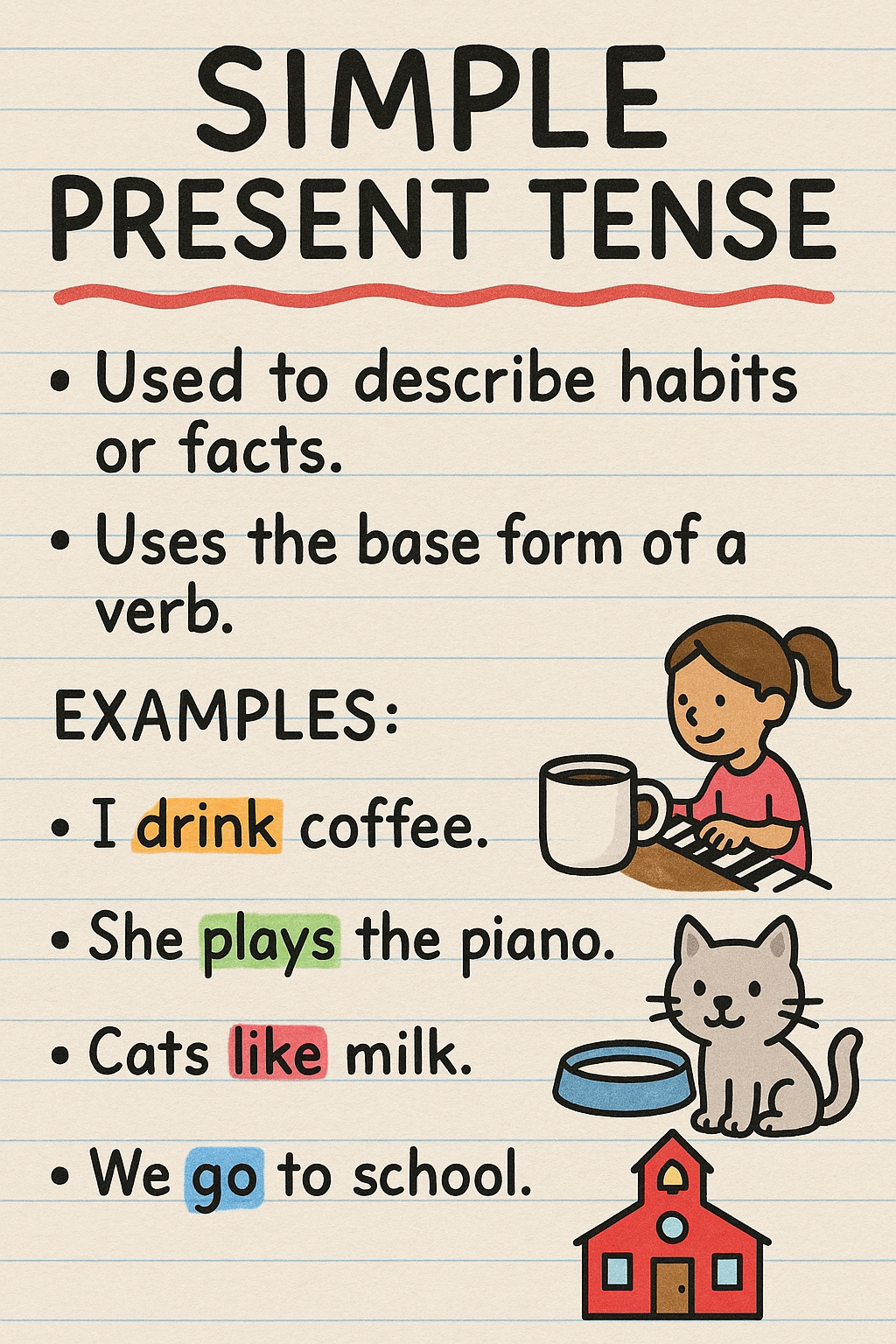
Simple present tense

Adjectives, Comparison of adjectives, Pronouns And verbs

Message Writing 4 th

📩 Message Writing

🌟 Objective:
To teach students how to write short and clear messages.

🧠 Skills Developed:
- Communication
- Writing clarity
- Format understanding

📚 Format:
1. Date
2. Name of the person
3. Message body
4. Sender’s name

✍️ Sample Message:
Date: 17 July 2025  
To: Mom  
Message:  
I have gone to Riya’s house to complete our homework. I will be back by 6 PM.  
From: Shiny

📝 Tips for Students:
- Keep it short and to the point.
- Mention important details like time, place, and reason.
- Use polite and clear language.


📩 More Examples of Message Writing

1. To a Friend
Date: 17 July 2025  
To: Riya  
Message:  
I am not coming to school today because I have a cold. Please tell the teacher.  
From: Shiny


2. To a Parent
Date: 17 July 2025  
To: Dad  
Message:  
I have gone to the library to return my books. I will be back by 5 PM.  
From: Shiny


3. To a Teacher
Date: 17 July 2025  
To: Miss Anita  
Message:  
I forgot to bring my notebook today. I will submit my homework tomorrow.  
From: Shiny


4. To a Sibling
Date: 17 July 2025  
To: Rahul  
Message:  
I have kept your football in the cupboard. Don’t forget to take it for practice.  
From: Shiny


5. To a Classmate
Date: 17 July 2025  
To: Aman  
Message:  
I have completed the science project. Let’s meet after school to check it together.  
From: Shiny


❓ Message Writing Practice Questions

Ask students to write messages for the following situations:

1. You are going to your friend’s house to study. Write a message to your mother.
2. You forgot your lunchbox at home. Write a message to your teacher.
3. You are going to the market with your uncle. Write a message to your father.
4. You borrowed a book from your friend. Write a message to return it tomorrow.
5. You are not feeling well and will miss school. Write a message to your class teacher.
6. You want to remind your brother to bring his umbrella. Write a message to him.
7. You are going to play in the park. Write a message to your sister.
8. You finished your homework early. Write a message to your friend to come and play.


📝 Message Writing Scenarios

🏫 School & Study
1. You forgot your math book at home. Write a message to your teacher.
2. You want to remind your friend to bring the science project tomorrow.
3. You are staying after school for extra classes. Write a message to your parents.
4. You missed a class and want your friend to share notes. Write a message to your friend.
5. You are going to the computer lab. Write a message to your class monitor.


🏡 Home & Family
6. You are going to your cousin’s house. Write a message to your mom.
7. You broke your sister’s toy by mistake. Write a message to say sorry.
8. You are helping grandma in the garden. Write a message to your dad.
9. You are watching TV in the living room. Write a message to your brother.
10. You are going to sleep early. Write a message to your parents.


🎉 Fun & Activities
11. You are going to a birthday party. Write a message to your friend.
12. You are playing cricket in the park. Write a message to your brother.
13. You are going to the zoo with your uncle. Write a message to your mom.
14. You are attending a dance class. Write a message to your sister.
15. You are going to buy ice cream. Write a message to your cousin.


🚨 Emergencies & Reminders
16. You lost your pencil box. Write a message to your teacher.
17. You saw a dog near the school gate. Write a message to the guard.
18. You want to remind your dad to bring your school bag from the shop.
19. You forgot to lock the door. Write a message to your sister.
20. You want to remind your friend to bring his water bottle tomorrow.

Perfect, Shiny! Based on the format in the image, here are more message writing examples and practice tasks for Class 3 students using the same structure:


📝 Message Writing Format

`
Date: [Insert Date]  
Time: [Insert Time]  

Message:  
Dear [Name],  
[Write your message here in 2–3 sentences.]  

From: [Your Name]
`


📚 Examples Using the Format

1. 🏫 School Homework
Date: July 17, 2025  
Time: 6:30 PM  

Message:  
Dear Riya,  
I forgot to write down the math homework today. Can you please tell me what we have to do?  
From: Shiny


2. 🏡 Going Out
Date: July 17, 2025  
Time: 4:00 PM  

Message:  
Dear Mom,  
I have gone to the playground with Aman. I will be back by 6 PM.  
From: Shiny


3. 🎉 Birthday Reminder
Date: July 17, 2025  
Time: 5:15 PM  

Message:  
Dear Rahul,  
Don’t forget to come to my birthday party tomorrow at 5 PM. It will be at my house.  
From: Shiny


4. 📚 Library Visit
Date: July 17, 2025  
Time: 3:45 PM  

Message:  
Dear Dad,  
I am going to the library to return my books. I will be home by 5 PM.  
From: Shiny


❓ Practice Tasks for Students

Ask students to write messages for these situations using the format:

1. You forgot your notebook in class. Write a message to your friend.
2. You are going to your cousin’s house. Write a message to your mom.
3. You missed school today. Write a message to your classmate asking about homework.
4. You are going to play in the park. Write a message to your sister.
5. You want to remind your friend to bring his crayons tomorrow.